
This review contains spoilers.
2.6 Phase Space
The division between Maeve and Dolores is becoming greater with each passing day in Westworld. Maeve is willing, completely, to allow those around her to follow their destiny, no matter what that might mean for her quest to get her daughter back and find somewhere safe from the torment of the world around her. Dolores gives lip service to the idea of freedom, but when push comes to shove, she’s deliberately tinkering with the brain of the man she loves and taking away… not his free will entirely, but a good portion of who he is and what makes his character. Teddy was a nice guy, a white-hat gunslinger trying to leave his past behind and make a home with a beautiful farmer’s daughter. That farmer’s daughter has turned him into some sort of moody Terminator.
It’s a fascinating bit of a turn for the character, and it’s a strong turn against type for James Marsden. He’s essentially type-cast as, at best, a straight-laced hero and, at worse, a nice guy who is a foil for rougher characters. His take on Teddy (the normal Teddy) is very much appealing—Marsden just comes across so well as a secretly sweet fellow with a bit of darkness in his past that he’s trying very much to get past—but it’s his work as Evil Teddy where he really works. He’s still very much that nice Teddy somewhere. Teddy remembers who he’s supposed to be, or who he truly is, but that nature is taken away from him, and every scene Teddy shares with Dolores crackles with unspoken tension between the two.
Teddy is both more aggressive and somehow nursing a core of hurt at the same time, and, at certain points, it looks as though Teddy is actively contemplating turning his gun on Dolores. That tension is a nice counterpoint to the positive arrangement that seems to be worked out with Maeve and her samurai associates. It’s still very touching to see how Maeve and Akane balance one another, if the flashbacks to Maeve and her daughter feel a little more on the nose this week than it had previously, but it is functional enough. It sets things up nicely for the second biggest emotional punch of the episode: Maeve tracks down her missing daughter and she has no idea who Maeve is, her mother having been recast by a different host.
It’s heartbreaking to see that realisation wash across Maeve’s face. Akane would have sacrificed herself for her “daughter” Sakura, and is dedicated to her. Maeve is similarly dedicated to her daughter, but her daughter has already forgotten her. Maeve’s suffering, dedication, and struggle has been for nothing, and she can’t even reprogramme her daughter to be her daughter once more because Maeve isn’t Dolores, and she’s not willing to force other hosts to follow her whims, except to preserve her life and the lives of her friends, and that difference in philosophy seems to show up a little bit more when Maeve actually needs support. She’s bonded with her associates, unlike Dolores, who prefers her minions (Teddy and Angela aside) to be faceless and nameless ghouls.
The power in these emotionally-charged moments isn’t so much in the script, but in the performance of the actors. Tarik Saleh, who I am completely unfamiliar with, seems to be a drama and crime director from what I can gleam from his IMDb page, and that background shows through in his handling of the actors and the emotional beats in this week’s episode. The episode unfolds a bit like a crime drama, tense and loaded. The duel between Musashi and Tanaka is beautifully done, with serious emotional impact and a real sense of danger. It’s an echo of last week’s brilliant samurai episode, just not as much of it.
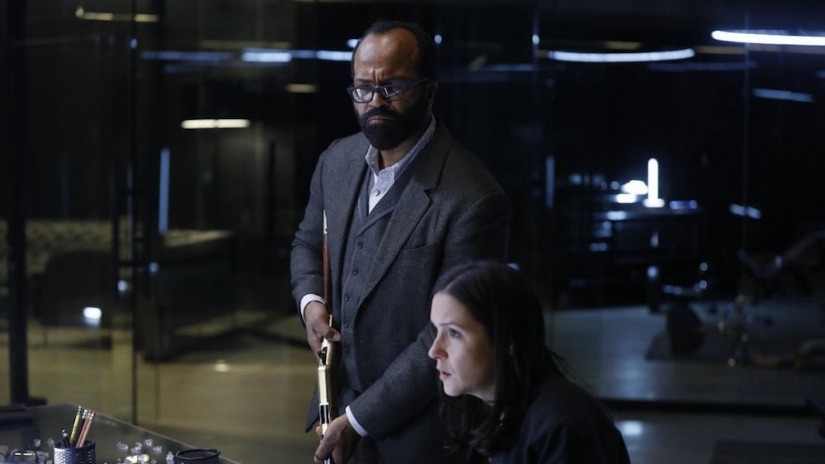
Bernard and Elsie also have a wonderful little series of exchanges, particularly Bernard’s trip into the central computer system, which takes on an aura of a dream in the brief moments we see of it. Their little interactions with one another are amusing enough, and Bernard’s opening and closing moments build a little bit more interest in a story that’s increasingly taking a back seat to Maeve and Dolores. Ditto the few appearances of William and daughter Emily/Grace, who have some very good moments together courtesy of Carly Wray’s script. Their father/daughter exchange is crafted well enough that it’s believable that William might give up his quest and reunite with his daughter, even if the betrayal pays off in laughs and not something more emotionally substantial.
There are lots of good moments in this week’s episode, but it feels a little too disconnected. After last week’s stronger outing, there are a few too many elements happening at once; there’s a new character introduced, every possible storyline gets rolled out and given some screen time, and there are jumps in both time and place that can be a little confusing. It’s a step back in terms of quality and focus, but there’s definitely variety and novelty. That, in and of itself, can be its own reward. Just not necessarily this week.
Read Ron’s review of the previous episode, Akune No Mai, here.
US Correspondent Ron Hogan didn’t get Zatoichi or Lone Wolf and Cub, but there was a brief moment of blind sword fighting and a cart full of weapons, so… no real complaints there. Find more by Ron daily at PopFi.